


w3c
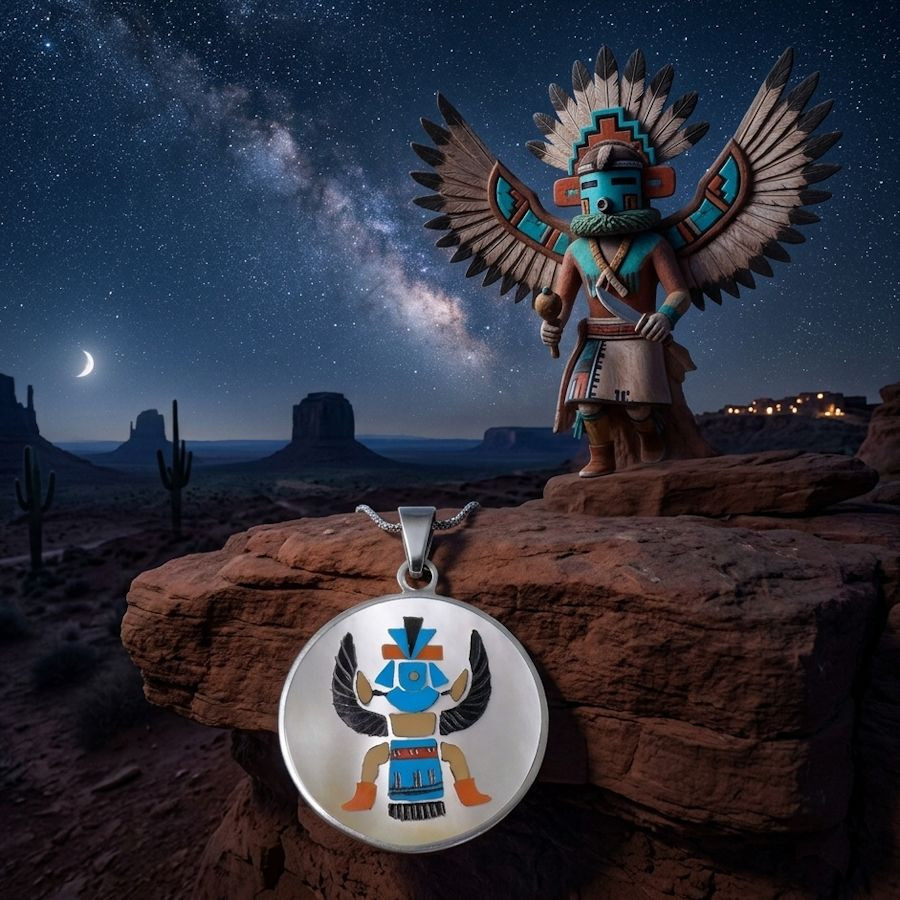
Hand-chiseled 925 sterling silver pendant set with stones, depicting the Kachina Knife Wing.
Dimensions:
A 5 cm x W 4 cm x D 3.8 cm - Weight 15 g.
 Garanties sécurité
(à modifier dans le module "Réassurance")
 Politique de livraison
(à modifier dans le module "Réassurance")
 Politique retours
(à modifier dans le module "Réassurance")

Hybrid Form: The Knifewing is depicted as a creature that is half-man, half-bird (often an eagle).
Flint Wings: Its most distinctive feature is that its wings and tail are made of sharp, knife-like flint blades, hence its name.
Divine Attributes: In traditional Zuni stories, it wears a crenellated headdress representing clouds. Its weapons include a flint war knife, a rainbow (which serves as a bow), and lightning arrows. It is considered a symbol of wisdom, strength, courage, honor, and protection.
Although it is an ancient mythological spirit, the Knifewing figure has become world-famous thanks to Native American jewelry, particularly the silverwork of Zuni and Navajo artisans in the 20th century.
Inlay Technique: The Knifewing motif is very frequently reproduced on brooches, rings, belt buckles, and bolo ties. Artisans use sterling silver combined with meticulously cut semi-precious stones (often turquoise, jet, coral, and mother-of-pearl).
Modern Use: When reproduced on these silver jewelry pieces intended for both commercial and artistic purposes, the Knifewing loses its strictly religious function to become a highly decorative motif and a masterpiece of Southwestern American craftsmanship.
In the Native American cultures of the Southwestern United States—specifically among the Hopi, Navajo, and Zuni peoples—the Kachina (or Katsina) embodies spirits from both the visible and invisible worlds. Kachinas represent the vital forces present in all things, such as rain, the sun, the wind, animals, plants, and ancestors.
Kachinas are represented in three complementary forms during rituals:
These are the invisible forces of nature—such as rain, the sun, the wind, fire, animals, or ancestors—that bring health, fertility, and abundant harvests.
For six months of the year, from the winter solstice until July, men from the village don masks and costumes during sacred ceremonies to physically embody these spirits.
Traditionally carved from cottonwood roots, these colorful figurines are given to children—especially young girls—at the end of festivals to teach them about mythology and help them become familiar with the spiritual world.
Chat with us on WhatsApp
